
What is a W-9 form? Why is my customer asking for it?
Clients and customers ask for a W-9 to get your tax information so they can report your payments to the Internal Revenue Service (IRS). If you’re an independent contractor, you’re typically obligated to provide this form to your clients – and if you don’t, they can refuse to work with you or withhold taxes from your payments.
A W-9 is a tax form used to verify a person’s name, address, and taxpayer identification number (TIN) for tax purposes. A W-9 can be requested for a U.S citizen or resident alien. But the way you fill it out varies based on your business structure and several other factors. To get help now, contact us at The W Tax Group today.
Key Takeaways
- The W-9 is an IRS form designed to collect the name, address, and tax identification number of an individual or business.
- Businesses use this form to collect tax information on independent contractors; banks use this form to collect info from customers who receive interest.
- Information collected in a W-9 is used to generate a 1099 tax form for income filing purposes.
- If you don’t fill out your W-9, your client is typically required to withhold 24% of your payment and forward it to the IRS.
- Individuals can use a Social Security Number, but for privacy, should consider using an EIN instead.
Who Should Complete a W-9?
You’ll need to fill out the W-9 if you are:
- A small business owner offering services to other businesses
- A freelancer or an independent contractor providing services to a business
- An individual or business receiving dividends, royalties, or certain interest payments
- A member of a partnership, LLC, or S corporation in certain payment situations
Check out the full list on the IRS website.
A W-9 should only be filled out by what the IRS calls a “U.S person,” which typically refers to residents, resident aliens, and businesses organized in the U.S. If you are not a U.S. person, you likely need to provide Form W-8 instead.
Before completing the W-9, ensure you’re classified as an independent contractor and not an employee. Check out our post on contractors vs employees to learn more about the distinction.
SSN vs. EIN: Which Should You Use?
The W-9 requires you to provide a Taxpayer Identification Number (TIN), which can be your Social Security Number (SSN) or an Employer Identification Number (EIN). While you can use either, independent contractors and freelancers may want to use an EIN for the following reasons:
- Protecting your personal identity from the risk of identity theft by limiting your SSN distribution.
- Looking more professional when working with established businesses.
- Helping to separate your business and personal finances, which also builds your business credibility
You can apply for an EIN at no cost through the IRS, and if you apply online, you get the number right away.
How to fill out your W-9 form
Here are line-by-line instructions on how to fill out a W-9 form, broken down into sections based on the layout of the form.
Provide Taxpayer’s Info – Filling Out the Top of the W-9 Form
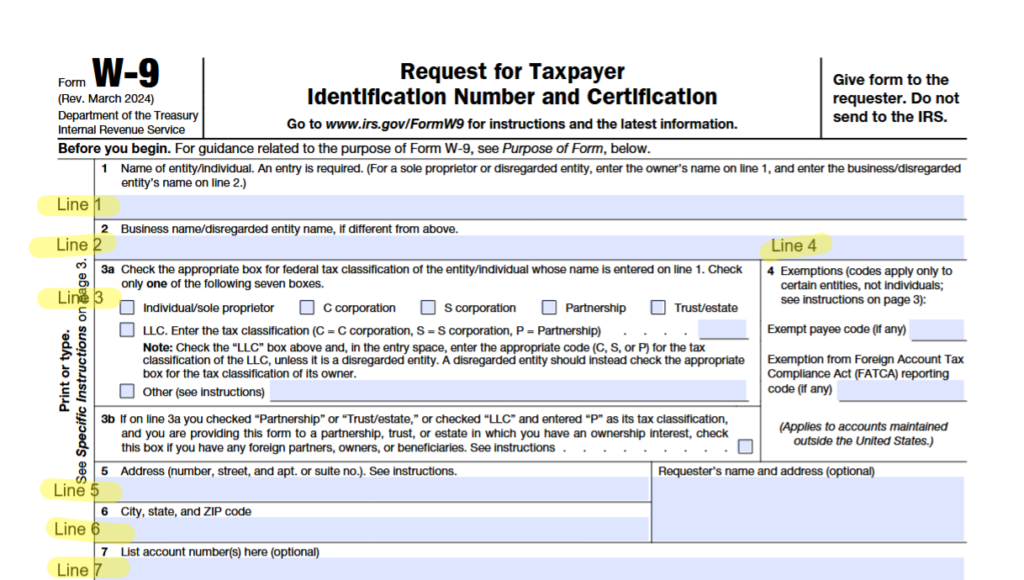
Line 1 – Name: This line should match the name on your income tax return. This is the legal name of you as an individual or as a company.
Line 2 – Business name: This line is optional and would include your business name, trade name, DBA name, or disregarded entity name if you have any of these. You only need to complete this line if your name here is different from the name on line 1. The purpose of line 2 is to help identify your company to your customer if the name on Line 1 is not one commonly known by your customer.
Line 3 – Federal tax classification: Check ONE box for your U.S. federal tax classification. This should be the tax classification of the person or entity name that is entered on line 1.
If the business is an LLC, here’s what you need to do based on how it’s taxed:
- Partnership – Check the “Limited liability company” box and enter “P” in the space provided.
- C-corp – If the LLC has filed Form 8832, check the “Limited Liability Company” box and in the space provided, enter “C” for C corporation.
- S-corp – If the LLC has filed Form 2553 to be taxed as an S corporation, check the “Limited Liability Company” box and in the space provided, enter “S” for S corporation.
- Disregarded entity – If the LLC is a single-member LLC (a disregarded entity), do not check the “Limited Liability Company” box; instead, select the tax classification of the owner of the LLC. If the owner of the LLC is another single-member LLC, select the first owner that is not a single-member LLC.
Use the “other” line for classifications that are not listed, such as nonprofits, governmental entities, etc.
Line 4 – Exemptions: If you are exempt from backup withholding, enter your exempt payee code in the first space. If you are exempt from FATCA reporting, enter your exemption from FATCA reporting code in the second space. Generally, individuals (including sole proprietors) are not exempt from backup withholding. See the “Specific Instructions” for line 4 shown with the W-9 form for more detailed information on exemptions.
Line 5 – Address: Enter your address (number, street, and apartment or suite number). This is where the requester of the W-9 form will mail your information returns to.
Line 6 – City, state, and ZIP: Enter your city, state, and ZIP code.
Line 7 (Optional) – Account numbers: This is an optional field to list your account number(s). It generally only applies if the company requesting your W-9 is a bank, brokerage, or vendor. We recommend that you do not list any account numbers, as you may have to provide additional W-9 forms for accounts you do not include.
Requester’s name and address: This is an optional section you can use to record the name and address of the person who requested the form.
Part 1 – Enter Your TIN Number on the W-9
Third Step – Enter your TIN number

Part I – Taxpayer Identification Number (TIN): Enter your taxpayer identification number here. This is typically a social security number (SSN) for an individual or sole proprietor and an employer identification (EIN)number for a company.
Part II – Sign your W-9 Form
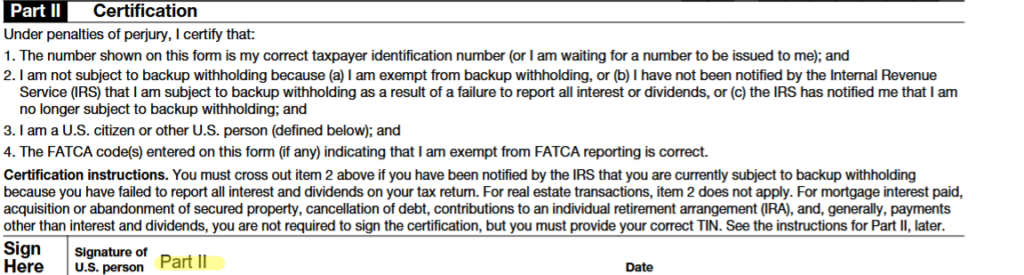
Part II – Certification: Sign and date your form. By signing, you certify the following under penalty of perjury:
- You’ve provided the real and correct TIN
- You’re not subject to backup withholding
- You’re a U.S. citizen or considered a U.S other person
- You’ve entered any FATCA codes correctly
If the IRS has notified you that you’re subject to backup withholding, ensure you cross out Item 2 under the certifications list. Wilfully and incorrectly representing this or any other details on your W-9 may be subject to criminal and civil penalties.
Here’s a table showing what to enter on each line of Form W-9:
| W-9 Line | What Goes Here | Common Mistakes to Avoid |
|---|---|---|
| Line 1 | Legal name – may be an individual or business | Using a business name for a sole prop; or the owner’s name for a business |
| Line 2 | Business name / DBA (if applicable) | Leaving blank when needed |
| Line 3 | Federal tax classification | Checking multiple boxes |
| Line 4 | Exemption codes (if applicable) | Assuming exemption without confirming |
| Line 5-6 | Address | Using an outdated mailing address |
| Line 7 | Account number(s) (optional) | Assuming it is required |
| Part I | SSN or EIN | Using the wrong TIN type |
| Part II | Signature and date | Forgetting to sign |
Frequently Asked Questions (FAQs)
Here are answers to the top questions we get on W-9s:
Who needs to fill out a W-9?
Any taxpayer who received income that wasn’t paid as an employee. It could be income from freelancing or independent contracting, or prizes and awards.
When is a W-9 required?
Typically, businesses ask you to complete a W-9 form before processing your payment. They’ll need this information to prepare 1099 forms at the end of the year.
Do I need to fill out a new W-9 form every year?
No, you’re only required to fill out a W-9 form when a business requests it after you offer your services as an independent contractor. Form W-9 is submitted to the requester and not the IRS.
What does list account numbers mean on W-9?
Line 7 account numbers are optional. This line does not apply to independent contractors/freelancers. You do not need to complete this line.
Banks or investment houses may want you to list account numbers on W-9s so they can match your tax ID info to your account. However, this line is always optional, and if you put in your account numbers, you may have to fill out a different W-9 for every account at that financial institution.
What should I do if I receive a W-9 request from a company I don’t recognize?
Ignore it or consult a tax professional. By law, you should only fill out a W-9 for parties that intend to pay you dividends, interest, non-employee compensation, or any other type of reportable income.
What happens after I complete Form W-9?
After you complete a W-9, you send it to the business that requested it. To prevent identity theft, send it using secure channels. If you use email, ensure you share it as an encrypted attachment. You can also send it by regular mail or hand delivery.
Not Sure How to Correctly Fill Your W-9? Let Us Help
To summarize, the Form W-9 is used to share information between two parties – for example, a business and an independent contractor. It ensures that the payments are properly recorded on Form 1099 or 1098 and then reported as income to the IRS.
Keep in mind that willingly including false information on a W-9 can result in civil or criminal penalties. If you’re not sure how to fill out your W-9 correctly, talk to us, and let the team at The W Tax Group guide you through the process.